
Solar Panel Planning Permission in South Yorkshire: The 2026 Homeowner’s Guide
- James

- 13 hours ago
- 12 min read
Your roof might be the perfect canvas for a clean energy revolution, but South Yorkshire’s deep industrial heritage could be the one thing standing between you and a lower carbon footprint. Navigating solar panel planning permission South Yorkshire is no longer just about following national trends. It is about understanding a local landscape where historic preservation and high-tech efficiency often collide. We know it feels daunting to weigh the benefits of solar PV against the fear of local council fines or complex "Article 4" directions that might restrict your property rights.
You likely believe that switching to renewables should be straightforward, and we agree. It is frustrating when confusing jargon about Permitted Development turns a visionary investment into a bureaucratic hurdle. This 2026 guide promises to clear the fog, giving you a definitive "yes or no" framework for your specific property. We will preview the latest 0.6-metre height restrictions for flat roofs, explain how conservation areas in Sheffield or Doncaster impact your plans, and demonstrate how our expertise removes the weight of paperwork from your shoulders. Our goal is to ensure you can focus on the pride of powering your home sustainably while we handle the technical complexities of local compliance.
Key Takeaways
Most residential properties qualify for automatic approval under 2026 Permitted Development rights, allowing you to bypass the traditional application process for standard roof installations.
Identify the specific technical triggers for solar panel planning permission South Yorkshire, such as the 200mm protrusion limit for pitched roofs and the updated 0.6-metre height allowance for flat surfaces.
Understand how local heritage protections and Article 4 Directions in areas like Broomhill or Nether Edge could necessitate a full planning application even for minor modifications.
Master the spatial constraints for ground-mounted solar arrays, including the strict 9-square-metre size limit and the required 5-metre distance from your property boundary.
Discover how a professional end-to-end partnership simplifies the transition by managing every regulatory detail from initial site survey to final local council liaison.
Table of Contents
Understanding Permitted Development in South Yorkshire
Permitted Development (PD) is the backbone of Britain's domestic energy transition. It effectively grants a blanket planning permission for specific home improvements, removing the need for a full, time-consuming planning application. For the vast majority of residents, securing solar panel planning permission South Yorkshire is simply a matter of adhering to these pre-defined national criteria. This streamlined approach reflects a serious commitment to decentralised energy production across the North.
Whether your home is in the urban heart of Sheffield, the industrial corridors of Rotherham, or the residential suburbs of Barnsley and Doncaster, the core rules remain consistent. Local planning authorities still maintain vital oversight, especially regarding safety and heritage. We often advise clients to secure a Lawful Development Certificate. This isn't a legal requirement, but it acts as a formal confirmation that your installation is compliant. It provides an essential paper trail for future property sales, proving your home meets all 2026 regulatory standards.
The pace of adoption is accelerating rapidly. According to recent UK Solar Power Statistics, domestic arrays are now a primary driver of the nation’s renewable capacity. This growth is fuelled by the relative ease of the planning process for standard residential dwellings. By following the PD framework, you ensure your project moves from concept to generation without unnecessary delays.
The General Rules for Pitched Roofs
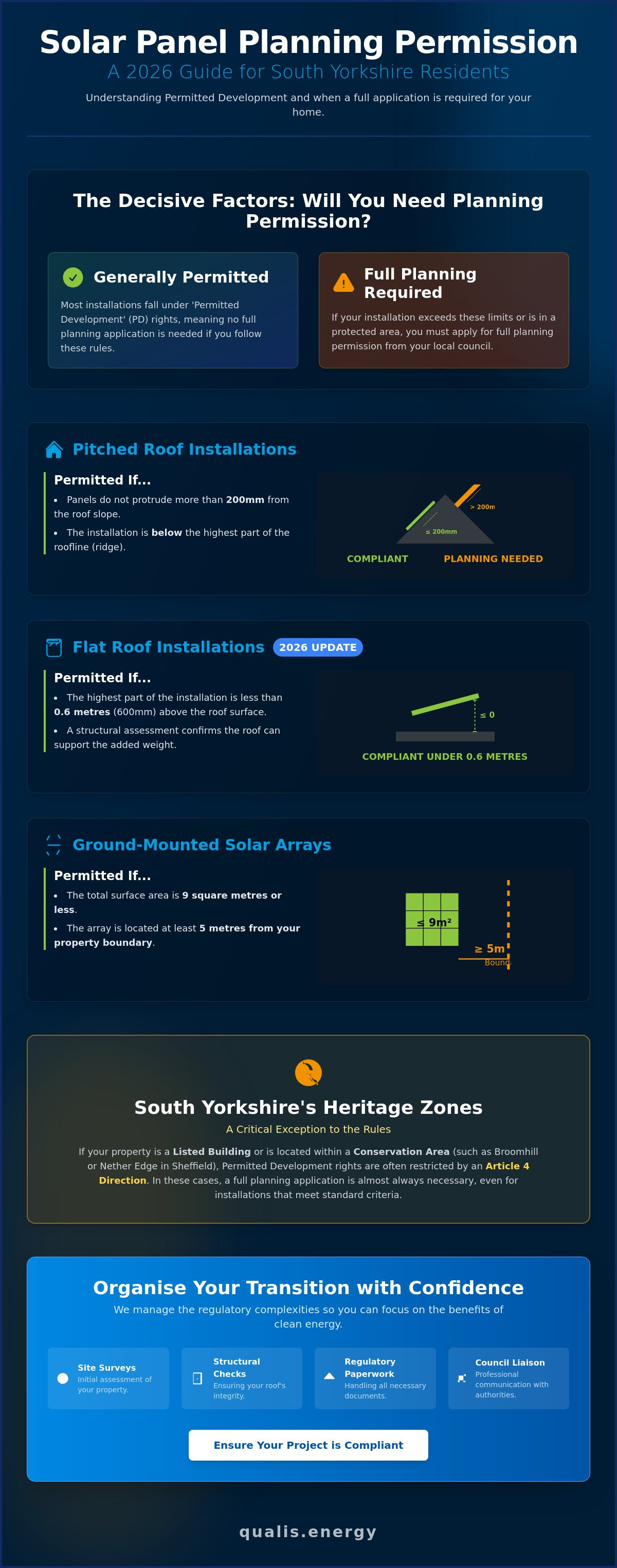
Pitched roofs are the natural home for most Solar PV systems. To stay within your PD rights, panels must not protrude more than 200mm from the roof slope. They must also sit below the highest point of the roofline, excluding the chimney. Councils across South Yorkshire expect homeowners to minimise the visual impact on the local landscape. This usually means choosing high-quality, low-profile panels that blend into the existing roofline of traditional slate or tile properties.
2026 Updates for Flat Roof Installations
Regulation finally caught up with technology in 2026. A significant update now allows solar panels on flat roofs to extend up to 0.6 metres above the roofline without requiring full planning permission. This change is a massive win for owners of terraced housing and modern apartments in Sheffield and Barnsley. It provides the necessary tilt to maximise energy harvest on previously restricted surfaces. However, South Yorkshire’s older building stock requires a cautious approach. The added weight of mounting systems means a structural assessment is a non-negotiable step to protect your property’s integrity.
Technical Constraints: When Planning Permission Becomes Mandatory
Crossing the threshold from a simple installation to a full planning application is often a matter of technical inches rather than a rejection of your environmental vision. Most homeowners find that their projects fit comfortably within Permitted Development, yet specific physical constraints can trigger a mandatory requirement for solar panel planning permission South Yorkshire. The most frequent trigger remains the protrusion rule. If your panels extend more than 200mm from the roof slope on a pitched surface, the local council demands a formal review to assess the visual impact on the streetscape.
Height is the second critical factor. Your installation must never exceed the highest part of the roofline, excluding the chimney. It is a common misconception amongst residents in Barnsley and Rotherham that a tall chimney stack allows for higher panel placement. In reality, the ridge of the main roof is your absolute ceiling. For those with flat-roofed extensions, the 2026 regulations offer more breathing room. The allowance for flat roof installations has been increased to 0.6 metres (600mm). This specific update allows for the necessary tilt required to maximise energy harvest without immediately involving a planning officer. You can cross-reference these specific limits on the official Permitted Development Rights for Solar Panels resource.
Non-Domestic and Commercial Criteria
Commercial properties and blocks of flats operate under a distinct regulatory framework. If you are investigating solar panels for business within South Yorkshire’s industrial hubs, capacity thresholds are your primary concern. Systems that exceed specific output levels often trigger additional scrutiny from the local planning authority. Furthermore, commercial-scale arrays require a G99 grid application to ensure the local infrastructure can safely manage the energy export. This process is complex, but it is an essential step in the region's transition to a high-capacity renewable grid.
Building Regulations vs. Planning Permission
Planning permission deals with the "where" and "what," but Building Regulations focus on the "how." Even if your project bypasses the planning department, it must still meet stringent safety standards. Your roof must be structurally verified to support the additional load and resist the wind uplift common in our part of the country. Every installation we manage adheres to MCS accreditation standards and electrical safety protocols. This comprehensive approach ensures your transition is both legally sound and physically secure. If you feel uncertain about these technical layers, it is often best to consult with a specialist team who can navigate both regulatory paths on your behalf.
South Yorkshire’s Heritage Zones: Conservation and Listed Buildings
Preserving the architectural soul of our region is a responsibility we take seriously. South Yorkshire boasts a rich tapestry of Victorian villas and industrial landmarks, particularly within Sheffield’s Broomhill and Nether Edge conservation areas. While these designations protect our local character, they also modify the standard permitted development rights that most homeowners enjoy. Securing solar panel planning permission South Yorkshire in these zones requires a more nuanced approach than a standard suburban installation. It is not about whether you can install solar; it is about how you can do it without compromising the aesthetic integrity of your street.
Local planning authorities like Sheffield City Council or Doncaster Metropolitan Borough Council aren't inherently opposed to renewable energy. They simply demand a higher level of sympathetic design. This often means ensuring panels are not visible from the public highway or choosing materials that mimic traditional roofing. If your property is a listed building, the challenge increases. You will likely need Listed Building Consent in addition to planning permission. This process examines every physical attachment to the historic structure. We guide you through this, ensuring your application for solar panel planning permission South Yorkshire highlights the environmental necessity alongside architectural sensitivity.
Article 4 Directions Explained
In certain pockets of Rotherham and Doncaster, councils have issued Article 4 Directions. These legal tools effectively withdraw specific development rights to prevent the gradual erosion of a neighbourhood's character. When these are in force, even minor changes that would normally be permitted require a full planning application. Check your local council’s interactive planning maps before making any assumptions. If an Article 4 is present, we assist by preparing detailed visual impact assessments. This proves your solar array supports the long-term viability of the heritage asset without damaging its historical value.
Solar Solutions for Listed Properties
Innovation has provided us with tools to satisfy even the most stringent heritage officers. Modern black-framed panels or all-black modules significantly reduce the visual contrast against dark slate roofs. For Grade II listed homes, we often propose placing the array on non-original outbuildings or the rear roof slopes, away from the primary facade. In a recent South Yorkshire project, we successfully integrated a high-performance system by using low-profile mounting that followed the existing roof pitch exactly. This collaborative approach turns a potential conflict into a showcase of how 21st-century technology can coexist with 19th-century craftsmanship.
Ground-Mounted Solar and Outbuildings
Ground-mounted solar represents a bold step towards energy autonomy. It is the ideal solution for South Yorkshire properties with expansive gardens or heavily shaded rooflines. To remain compliant with solar panel planning permission South Yorkshire, you must adhere to specific spatial constraints. The total area of a domestic ground-mounted array must not exceed 9 square metres. This limit ensures your installation remains proportionate to the residential setting whilst providing a reliable energy yield for your household.
Height and boundary placement are non-negotiable. Your structure must not exceed 4 metres in height; it must also sit at least 5 metres from any property boundary. These regulations protect the visual amenity of neighbouring residents. In the more rural fringes of Barnsley and Doncaster, we often recommend natural screening, such as native hedgerows, to help standalone systems blend seamlessly into the landscape. Navigating solar panel planning permission South Yorkshire for these standalone structures is straightforward if you respect these primary dimensions from the outset.
Criteria for Standalone Systems
Only one standalone solar array is permitted per property under Permitted Development rights. If you intend to install a second array or exceed the 9-square-metre threshold, a full planning application becomes mandatory. This "one-shot" rule makes the initial design phase critical. We focus on high-efficiency monocrystalline panels to ensure you get the maximum possible generation from that restricted footprint, ensuring your environmental commitment is both legally compliant and physically productive.
Solar Carports and Outbuildings
Solar-integrated outbuildings are becoming a favourite amongst South Yorkshire EV owners. Converting a garage or carport roof into a dedicated power station provides a clean, direct source for vehicle charging. This forward-thinking approach often involves pairing your panels with an air source heat pump installation. By synchronising these technologies, you move your home towards total resource independence. Our team handles every regulatory and technical detail, ensuring your outbuildings are both high-performing and legally secure. Talk to our experts about your ground-mounted solar project today.
Organising Your Transition with Qualis Energy
Choosing to power your home with the sun is a statement of intent. It marks your participation in a critical national transition toward a cleaner, more resilient South Yorkshire. However, the path from aspiration to generation is paved with regulatory nuance. We exist to ensure that securing solar panel planning permission South Yorkshire never becomes a barrier to your progress. Our team provides end-to-end management, bridging the gap between complex industrial technology and the comfort of your daily life. Our expertise in solar panels and installation spans the entire region, from the historic streets of Sheffield to the growing communities of Doncaster.
We don't just install hardware; we secure your investment's future. By handling the Lawful Development Certificate on your behalf, we provide the legal certainty that your system adheres to every 2026 standard. This meticulous attention to detail extends to MCS compliance, a vital requirement for accessing the Smart Export Guarantee (SEG) tariff. It ensures your system is not only generating power but also generating a financial return. This creates a narrative of completeness and reliability, suggesting that your journey is fully mapped out before the first panel is even lifted.
The Qualis Energy Consultation Process
Our consultation begins with a rigorous feasibility study. We analyse roof shading, structural integrity, and local aesthetic requirements to create a bespoke design that respects South Yorkshire’s unique heritage. This phase includes a transparent breakdown of renewable energy incentives available in 2026. We believe in total clarity, moving you logically from initial conceptual phases through to final implementation and ongoing support.
Ongoing Support and Maintenance
Our commitment is a long-term partnership. We integrate your solar PV with advanced battery storage and smart management systems to maximise your ROI. Crucially, we understand how different technologies interact within a home. The planning requirements for solar often overlap with those for other renewable systems, such as heat pumps. Our expertise includes air source heat pump servicing, allowing us to manage your entire domestic infrastructure under one expert hand. This holistic approach removes the effort for the client, providing a sense of mission that goes beyond mere business. Book your local South Yorkshire survey today to begin your transformation.
Secure Your Energy Independence in South Yorkshire
Your journey toward sustainable living is a significant step for both your household and our wider region. Whilst the 2026 regulations for solar panel planning permission South Yorkshire offer more flexibility than ever, the technical nuances of conservation areas and structural limits require an expert hand. We've explored how Permitted Development simplifies most projects, yet the value of professional oversight in heritage zones or complex ground-mounts remains vital.
As a local MCS Accredited Installer, Qualis Energy brings deep expertise in South Yorkshire planning law and comprehensive 2026 renewable energy integration. We manage every detail, from initial feasibility to the final Lawful Development Certificate. This ensures you enjoy the pride of clean generation without the stress of paperwork. The transition to a greener future is a mission we share. It's time to turn your property into a powerhouse. Book your South Yorkshire solar feasibility survey with Qualis Energy today and lead the charge toward a cleaner tomorrow.
Frequently Asked Questions
Do I need planning permission for solar panels in a conservation area in Sheffield?
Generally, you won't need full planning permission for roof-mounted panels in a conservation area unless they are installed on a wall fronting a highway. Sheffield City Council maintains strict oversight to preserve the character of neighbourhoods like Broomhill or Nether Edge. It's essential to verify if an Article 4 Direction is in place, as this could withdraw your standard rights. We recommend a sympathetic design that minimises visual impact on the historic streetscape.
What are the 2026 height limits for solar panels on flat roofs?
Current 2026 regulations allow solar panels on flat roofs to protrude up to 0.6 metres (600mm) above the roofline without requiring a full planning application. This specific allowance is a significant improvement for homeowners in urban areas of Barnsley and Sheffield, as it provides the necessary clearance for optimal panel angling. Provided the installation doesn't exceed the highest part of the main roof, it typically falls under Permitted Development.
Can I install solar panels on a listed building in South Yorkshire?
Installing solar on a listed building is possible, but it almost certainly requires Listed Building Consent. This is a distinct legal process from standard solar panel planning permission South Yorkshire. Heritage officers will scrutinise the physical impact on the structure's historic fabric. Success often depends on using low-profile mounting or placing arrays on non-original outbuildings. We specialise in navigating these complex heritage requirements to ensure your transition is both clean and compliant.
How much does planning permission for solar panels cost if I need it?
Planning application fees are set by individual local authorities and vary between Sheffield, Rotherham, Doncaster, and Barnsley councils. Because these fees are subject to local government review, you should confirm the current tariff directly with your specific planning department. These costs are external to our installation services. If your project qualifies as Permitted Development, you can avoid these fees entirely, though we still suggest securing a Lawful Development Certificate.
Do I need my neighbours’ permission to install solar panels?
You don't legally require your neighbours' permission if your installation fits within Permitted Development criteria. However, if your project triggers a full planning application, the local council will formally notify adjacent properties as part of the consultation process. Maintaining positive community relations is always a wise strategy. We find that early, transparent communication about your environmental commitment often resolves potential concerns before they reach the planning office.
What is a Lawful Development Certificate and do I need one?
A Lawful Development Certificate (LDC) is a formal document issued by your council that proves your solar installation was legal at the time of construction. Whilst not a mandatory requirement, it provides vital peace of mind and acts as a definitive record for future property buyers. It confirms that you've correctly navigated solar panel planning permission South Yorkshire. We handle the LDC application process on your behalf to ensure your property's paperwork is impeccable.
Are ground-mounted solar panels allowed under Permitted Development?
Yes, ground-mounted arrays are allowed under Permitted Development provided they meet three strict conditions. The total area must be under 9 square metres, the height must not exceed 4 metres, and the structure must sit at least 5 metres from your property boundary. Only one standalone array is permitted per property. These rules ensure that even large-scale domestic generation remains proportionate to the local South Yorkshire landscape.
Does planning permission cover solar battery storage systems?
Most domestic battery storage installations are considered Permitted Development because they are typically housed internally or within existing outbuildings. They rarely require a separate planning application unless they involve a significant external structure that alters the property's appearance. As part of our comprehensive 2026 renewable energy integration, we assess your entire system's footprint. This ensures every component, from the panels to the storage units, meets local regulatory standards.


Comments