
Commercial Solar for Warehouses in Rotherham: The 2026 Strategic Asset Guide

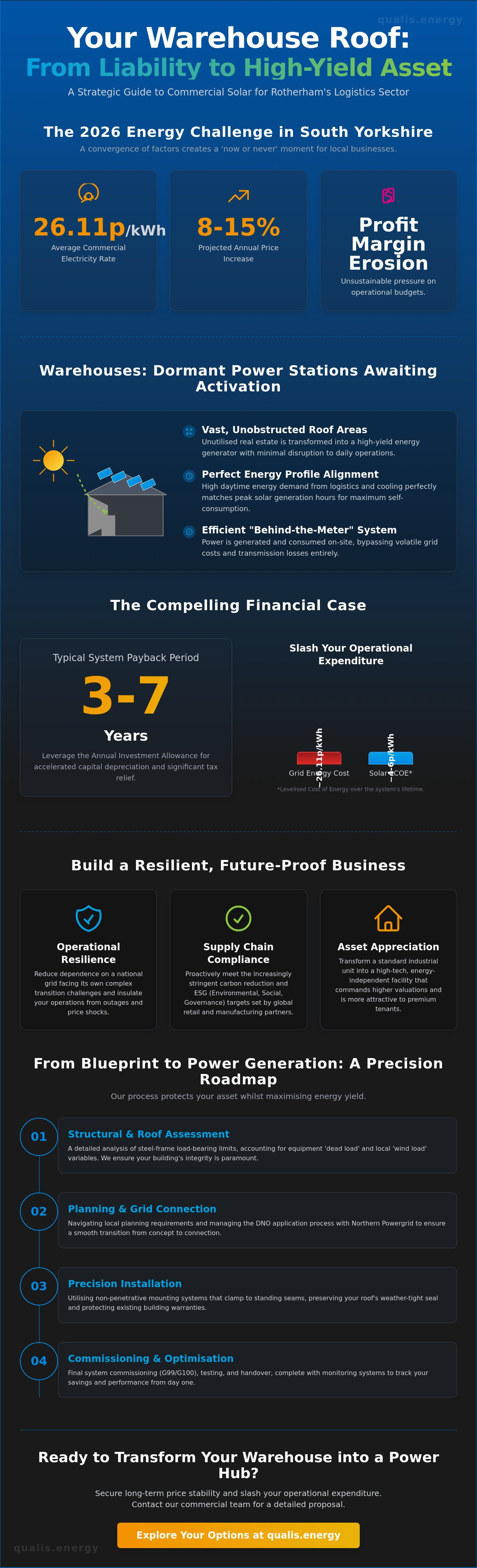
What if your warehouse roof was actually a hidden revenue stream rather than just a maintenance liability? For logistics and cold storage operators across South Yorkshire, the reality of commercial solar for warehouses in Rotherham has shifted from an environmental 'nice-to-have' to a core defensive strategy. With commercial electricity rates in the region averaging 26.11p/kWh in 2026, the financial drain of 24/7 operations is becoming unsustainable for many. We understand that whilst the desire for energy independence is strong, the technical hurdles of grid connections and roof integrity often feel like insurmountable barriers.
This guide promises to demystify the transition, showing you how to secure long-term price stability and slash your operational expenditure. We'll explore the immediate benefits of the Annual Investment Allowance, navigate the complexities of Northern Powergrid applications, and outline how a typical system in our region now pays for itself in as little as three to seven years. From initial structural assessments to final commissioning, here is your roadmap to transforming dormant space into a high-performance energy asset.
Key Takeaways
Identify why the current energy climate in South Yorkshire makes 2026 the definitive year to transition your facility into a self-sustaining power hub.
Navigate the complexities of Northern Powergrid applications and local planning to ensure your project moves from concept to connection without friction.
Master the technical considerations of steel-frame load-bearing and roof suitability to protect your asset whilst maximising energy yield.
Calculate the true ROI of commercial solar for warehouses in Rotherham by leveraging the Annual Investment Allowance and high-efficiency self-consumption models.
Learn how to combine solar PV with battery storage and heat pumps to achieve total HVAC decarbonisation and long-term price certainty.
Table of Contents
The Energy Challenge for Rotherham’s Industrial and Logistics Sector
Rotherham’s skyline is undergoing a profound transformation. The heavy chimneys of the industrial past have been replaced by the sprawling, modern silhouettes of the Dearne Valley and the Advanced Manufacturing Park (AMP). These hubs represent the new engine room of South Yorkshire, yet they face a silent and escalating threat to their stability: energy market volatility. For many operators, commercial solar for warehouses in Rotherham has shifted from being an aspirational environmental goal to a critical defensive strategy. Commercial solar PV involves the installation of high-capacity photovoltaic arrays designed specifically to meet the intense, constant demand of industrial operations through direct self-consumption.
We've reached a definitive tipping point in 2026. The convergence of high grid costs and the final window for regional decarbonisation grants has created a "now or never" moment for local businesses. In the Yorkshire region, average electricity rates have settled around 26.11p/kWh, which directly erodes the profit margins of logistics firms operating on thin spreads. By generating power at the point of use, businesses can effectively bypass these rising costs and reclaim control over their overheads.
Rotherham's Industrial Energy Landscape in 2026
The town has successfully transitioned from its heritage in heavy steel to a future defined by advanced manufacturing and high-tech logistics. This evolution requires a sophisticated approach to resource management that matches the precision of the work being done inside these facilities. The South Yorkshire Mayoral Combined Authority is currently driving an aggressive regional decarbonisation agenda, which places increased scrutiny on the environmental performance of local firms. Currently, the trend for 2026 indicates that industrial electricity prices are continuing to climb at an annual rate of between 8% and 15%. This sustained rise makes the expansion of UK solar power capacity a vital benchmark for local companies seeking long-term energy security.
Why Warehouses are the Ideal Candidates for Solar PV
Warehouses are essentially dormant power stations waiting to be activated. Their vast, unobstructed roof areas represent unutilised real estate assets that can be converted into high-yield energy generators with minimal disruption to daily operations. The unique energy profile of a logistics hub aligns perfectly with peak solar generation. Because high daytime energy demand matches the hours when the sun is highest, the power generated is used immediately. This creates a highly efficient "behind-the-meter" system. Beyond the immediate financial relief, these installations provide the following benefits:
Supply Chain Compliance: Meet the increasingly stringent carbon reduction targets set by global retail and manufacturing partners.
Asset Appreciation: Transform a simple shell into a high-tech, energy-independent facility that commands higher valuation.
Operational Resilience: Reduce reliance on a national grid that is facing its own transition challenges.
By treating the warehouse roof as a strategic asset, Rotherham businesses aren't just saving money. They're building a more resilient, future-proof foundation for the next decade of South Yorkshire’s industrial growth.
Maximising Warehouse Potential: Structural and Technical Considerations
Transforming an industrial roof into a power plant requires more than just bolting down panels. It's a precision engineering exercise that starts with the skeleton of the building itself. Most warehouses in South Yorkshire feature large-span steel frames. These structures are robust, yet they have specific load-bearing limits that must be respected. When planning commercial solar for warehouses in Rotherham, we must account for the 'dead load' of the equipment and the 'wind load' variables unique to our local topography. Our goal is to ensure the building remains as secure as the energy prices we're fixing.
The mounting strategy is equally vital. For modern composite panels, we prioritise non-penetrative mounting systems. These clamps attach directly to the standing seams of the roof, preserving the weather-tight seal and, crucially, protecting your existing building warranties. This approach removes the risk of leaks and structural degradation over the system's long life. If you're unsure about your roof's current capacity, our team can provide a detailed technical assessment to map out your options safely.
Structural Integrity and Roof Lifespan
A professional structural survey is a non-negotiable first step. We don't just look at the steelwork; we evaluate the skin. In older industrial zones across Rotherham, some facilities still feature legacy materials, including asbestos-containing materials (ACMs). Handling these requires specialist expertise to ensure that the installation of a solar array doesn't disturb the fabric of the building. It's also essential to match the solar system's 25-year lifespan with the remaining life of the roof. If a roof is nearing the end of its natural cycle, we often coordinate a refurbishment alongside the solar transition to ensure the entire asset is future-proofed in one move.
High-Efficiency Technology for Rotherham's Climate
Maximising yield in the UK's diffused light conditions requires specific hardware choices. We often recommend Tier 1 bifacial panels. These capture sunlight on both sides, utilising light reflected off the roof surface to increase total output. This is particularly effective on the light-coloured membranes often found on modern logistics hubs. According to the government's Solar Taskforce, the untapped potential of commercial rooftops is a primary pillar of the UK's energy strategy, and using high-efficiency tech is how we realise that potential. For large-scale arrays, we balance the use of robust string inverters with sophisticated monitoring software. This provides your operations team with real-time data, allowing you to align energy-intensive tasks, like charging electric fleets or running heavy machinery, with peak generation windows.
Economic ROI: Calculating Savings for South Yorkshire Warehouses
Solar pays. It's that simple. Whilst the initial capital outlay for a large-scale array can be substantial, the transition from a variable operational expense to a fixed capital asset fundamentally changes the balance sheet of a South Yorkshire logistics hub. When we talk about commercial solar for warehouses in Rotherham, the primary driver of value is the 'Self-Consumption' model. This strategy ensures that the electricity produced by your roof is used immediately by your conveyors, refrigeration units, or charging bays. By avoiding the need to purchase grid power at the current average rate of 26.11p/kWh, you're effectively locking in your energy costs for the next quarter of a century.
Under current market conditions, most warehouse installations in our region see a full payback within three to seven years. This timeline is accelerated by the Annual Investment Allowance (AIA), which allows businesses to deduct 100% of the installation cost from their taxable profits in the first year, up to a limit of £1 million. The financial viability of these projects is further bolstered by the regulatory ease provided by UK permitted development rights for solar, which eliminates much of the upfront planning risk and associated costs. For smaller operators, the South Yorkshire Low Carbon Project Grant provides an additional layer of support, offering part-funding for energy-saving improvements until March 2026. Investing in commercial solar for warehouses in Rotherham is no longer a speculative venture; it's a proven method of capital preservation.
Direct Savings vs. Long-term ROI
Viewing solar as a hedge is the most accurate way to assess its value. As commercial electricity prices continue to fluctuate, your on-site generation acts as a buffer that protects your margins from sudden spikes. The speed at which you recoup your initial investment is directly proportional to your self-consumption rate, as every kilowatt-hour generated on-site replaces a unit purchased from the grid at retail prices. Whilst the Smart Export Guarantee (SEG) allows you to sell surplus energy back to the grid, the rates are significantly lower than the cost of buying power. Therefore, the goal is always to use as much of your own energy as possible. Solar arrays are also remarkably low-maintenance, requiring only periodic cleaning and electrical checks to maintain peak efficiency, with most Tier 1 panels carrying 25-year performance warranties.
Battery Storage: Is it Worth it for Your Warehouse?
For warehouses with 24/7 operations or significant overnight security loads, adding storage is often the missing piece of the puzzle. It allows you to capture the surplus energy generated during the peak of the day and deploy it when the sun goes down. This is particularly effective for 'peak shaving', where you use stored energy to avoid expensive grid charges during high-demand periods. Integrating Solar PV & Battery Storage solutions ensures that your facility remains powered by clean, free energy even during the hours of darkness. This doesn't just reduce your carbon footprint; it provides a level of energy independence that was previously impossible for industrial sites, turning your roof into a truly autonomous power station.
Navigating Planning and Grid Connection in Rotherham
The grid is the gatekeeper. Whilst the physical installation of commercial solar for warehouses in Rotherham is often straightforward, the administrative journey to secure a connection requires meticulous management. In our region, Northern Powergrid manages the local infrastructure, and their approval is the bridge between your roof and the wider energy network. This process is not merely a formality; it is a technical negotiation that determines how much power you can generate and, crucially, how much you can export. Navigating these hurdles early ensures that your project remains a viable strategic asset rather than a stranded investment.
Most industrial installations require a G99 application. This is a formal request for any system exceeding 3.68kW per phase, which covers virtually every warehouse project in South Yorkshire. Because our industrial zones are becoming increasingly dense with renewable generation, early engagement is essential. If you are ready to assess your site's potential, you should request a grid feasibility study before committing to hardware purchases.
The DNO Application Process Simplified
The DNO application must happen before you sign a contract. Northern Powergrid assesses the local transformer capacity to ensure your system won't destabilise the local network. In high-density industrial zones like the Dearne Valley, we occasionally encounter grid constraints where the network is already at its limit. In these scenarios, we implement export limitation devices. These sophisticated controllers ensure your system never pushes more power into the grid than the network can handle, whilst still allowing you to generate and consume 100% of the solar energy internally. This proactive approach allows projects to proceed even in areas where the grid is technically 'full'.
Local Planning and Compliance
For the majority of Rotherham's industrial estates, solar installations fall under Permitted Development Rights. This means you can often bypass a full planning application, provided the panels don't protrude more than 200mm from the roof surface. However, nuances exist for warehouses located near heritage sites or within conservation areas. Rotherham Metropolitan Borough Council maintains specific standards for buildings that might impact the visual amenity of the region's historic landmarks. Beyond planning, we must also adhere to strict building regulations and fire safety standards. This includes ensuring that the DC cabling and inverter placement meet the latest industrial safety codes, which is a prerequisite for maintaining your building's insurance coverage and operational compliance.
Future-Proofing Your Facility with Qualis Energy
Qualis Energy stands at the forefront of a critical national transition. We believe that your warehouse is more than just a storage space; it's the engine room of South Yorkshire's future economy. Our approach combines visionary authority with grounded, reassuring professionalism to ensure your transition to renewable energy is seamless. By choosing us, you're partnering with a team that understands the specific demands of the Dearne Valley and the AMP. We manage every granular detail of your project, from the initial conceptual phases through to final implementation and long-term support. Investing in commercial solar for warehouses in Rotherham is the first step toward a broader energy revolution for your business.
A Holistic Energy Strategy
Solar PV is the bedrock of a modern, decarbonised facility. Once your roof is generating clean, free electricity, you can leverage that power to run other high-efficiency systems. We specialise in integrating solar arrays with Air Source Heat Pumps to provide total HVAC decarbonisation. This synergy allows you to heat and cool your warehouse whilst significantly reducing your reliance on gas and the volatile grid. Solar is the foundation for an Air Source Heat Pump transition, as it provides the low-cost electrons needed to run these high-performance systems. Combining air conditioning with solar generation is particularly effective for managing thermoregulation in temperature-sensitive logistics hubs. To ensure your system continues to perform at its peak for decades, we offer comprehensive Maintenance & Servicing plans. This proactive care protects your 25-year investment and guarantees that your energy yield remains as high as possible.
Next Steps for Your Rotherham Warehouse
The journey to energy independence begins with a clear, data-driven plan. We provide bespoke feasibility studies and roof structural audits to identify the exact potential of your facility. Our team handles the complex DNO applications and local planning requirements on your behalf, removing the burden from your operations team. We take pride in our end-to-end capability, mapping out every milestone so you can focus on your core business whilst we secure your energy future. Now is the time to act. If you're ready to transform your roof into a high-yield asset, Contact Qualis Energy for a Commercial Solar Consultation today. Let's build a more resilient, sustainable Rotherham together.
Securing Your Position in Rotherham’s Energy Future
The transition to renewable infrastructure is no longer a distant prospect; it's the definitive strategy for industrial resilience in 2026. By adopting commercial solar for warehouses in Rotherham, you're effectively converting a static roof into a dynamic energy asset that shields your margins from the unpredictability of the national grid. We've explored how the combination of high-yield technology, strategic self-consumption, and tax incentives like the Annual Investment Allowance can deliver a full return on investment in as little as three years. This isn't just about carbon reporting; it's about securing the long-term viability of your South Yorkshire operations.
Success in this transition requires more than just hardware. It demands an expert hand to manage the technical complexities of Northern Powergrid connections and the structural nuances of large-span steel buildings. As MCS Accredited Installers and specialists in industrial steel-frame structures, we provide the local South Yorkshire support and maintenance needed to ensure your system performs for its entire 25-year lifespan. It's time to stop paying for the grid's volatility and start generating your own stability. We're here to facilitate every step of that journey.
Book Your Free Rotherham Warehouse Energy Audit with Qualis Energy and take the first step toward total energy independence. Your facility’s next chapter starts with the sun.
Frequently Asked Questions
Do I need planning permission for solar panels on my warehouse in Rotherham?
Most warehouse solar projects in South Yorkshire fall under Permitted Development Rights, meaning formal planning permission isn't usually required. This applies as long as the panels don't protrude more than 200mm from the roof slope and aren't installed on listed buildings. However, if your facility is located near a heritage site, we'll need to consult with Rotherham Metropolitan Borough Council. We manage this entire verification process on your behalf to ensure total compliance before any work begins.
How long does a typical commercial solar installation take for a warehouse?
A typical installation on an industrial roof usually takes between two to four weeks for the physical work to be completed. The total project timeline is often longer, as it includes the mandatory Northern Powergrid DNO application and structural audits. We coordinate the entire schedule to minimise disruption to your logistics, ensuring that your transition to commercial solar for warehouses in Rotherham is as smooth and efficient as possible.
Can my warehouse roof support the weight of a large solar array?
Most modern steel-frame warehouses are designed with enough structural reserve to support a solar array, but a professional survey is always mandatory. We evaluate the load-bearing capacity of your specific frame and the condition of the roof skin. If your roof requires reinforcement or refurbishment, we'll identify this during the feasibility stage. This ensures the building remains safe and your warranties stay intact throughout the system's life.
What happens to the solar energy if my warehouse is closed at the weekend?
If your facility isn't using power at the weekend, the surplus energy is automatically exported back to the grid. Under the Smart Export Guarantee (SEG), your energy supplier will pay you for this excess electricity. Alternatively, many businesses choose to integrate battery storage. This allows you to capture that weekend sun and use it to power your operations on Monday morning, significantly increasing your overall self-consumption and financial savings.
How do I maintain commercial solar panels to ensure peak performance?
Maintaining your solar array is straightforward and involves an annual professional inspection and periodic cleaning. We check the electrical integrity of the string inverters and cabling to ensure everything is operating safely. Because warehouses are often located in industrial zones with higher dust levels, regular cleaning is vital to prevent soiling from reducing your energy yield. Our maintenance and servicing plans are designed to handle this without any effort from your side.
What is the typical lifespan of a commercial solar PV system?
You can expect a high-quality commercial solar PV system to have a functional lifespan of 25 to 30 years. Most Tier 1 panels come with a 25-year linear performance warranty, ensuring they still produce at least 80% of their original output after two and a half decades. The inverters typically require a replacement or service after 10 to 15 years. This longevity makes solar one of the most stable long-term investments available for industrial property.
Is there any financial support or grants for commercial solar in South Yorkshire?
Businesses in South Yorkshire currently benefit from several powerful financial incentives. The Annual Investment Allowance allows you to deduct 100% of the installation cost from your taxable profits in the first year. Additionally, the South Yorkshire Low Carbon Project Grant offers part-funding for energy-saving improvements until March 2026. These schemes significantly reduce the upfront cost of commercial solar for warehouses in Rotherham, accelerating your path to a full return on investment.
Can I install solar panels if my warehouse has an asbestos roof?
Yes, it's possible to install solar on an asbestos roof, but it requires a specialist approach to ensure safety and compliance. We don't drill into asbestos; instead, we often use over-cladding techniques or specialised mounting systems that avoid disturbing the hazardous fibres. In many cases, we recommend a roof refurbishment alongside the solar installation to future-proof the building. This transforms a potential liability into a productive, energy-generating asset for your business.


Comments