
Is it Worth Getting a Solar Battery in the UK 2026? A Comprehensive Investment Guide

Energy independence is no longer a distant aspiration. In 2026, a home battery is a high-performing financial asset that shields your household from a volatile energy market. With the energy price cap set to rise by 13% this July, many homeowners are urgently asking: is it worth getting a solar battery in the UK 2026? We understand the hesitation. Between the complexity of smart export tariffs and conflicting reports on battery lifespan, deciding to invest can feel like a daunting task.
This guide cuts through the noise to help you decide if solar storage aligns with your financial goals. We'll explore why the looming end of the 0% VAT rate in March 2027 makes this a critical year for your transition to renewables. You'll discover how to maximise self-consumption, protect your home against power cuts, and turn your solar array into a tool for long-term savings. From mastering the latest BS 7671 safety regulations to synchronising storage with electric vehicles, we provide the clarity you need to master your own energy future.
Key Takeaways
Understand why the 2026 transition from passive energy saving to active management is essential for mitigating the impact of rising electricity unit rates.
Evaluate the true financial impact of avoided grid costs to decide if it is worth getting a solar battery in the UK 2026 for your specific household needs.
Discover how to position a battery as the central hub of your home to efficiently power air source heat pumps and electric vehicles.
Learn about the safety benefits of Lithium Iron Phosphate (LFP) chemistry and the importance of complying with the latest BS 7671 wiring regulations.
Identify how bespoke system design and professional MCS accreditation ensure your investment remains a high-performing asset for decades.
Table of Contents
The UK Energy Landscape in 2026: Why Storage is No Longer Optional
The UK energy sector is undergoing a profound transformation. We've moved past the era of simply installing panels and hoping for the best. In 2026, the question of is it worth getting a solar battery in the UK 2026 is answered by the shift from passive saving to active resource management. You aren't just a consumer anymore; you're a micro-utility manager. The grid is changing. You need a buffer to stay ahead of it.
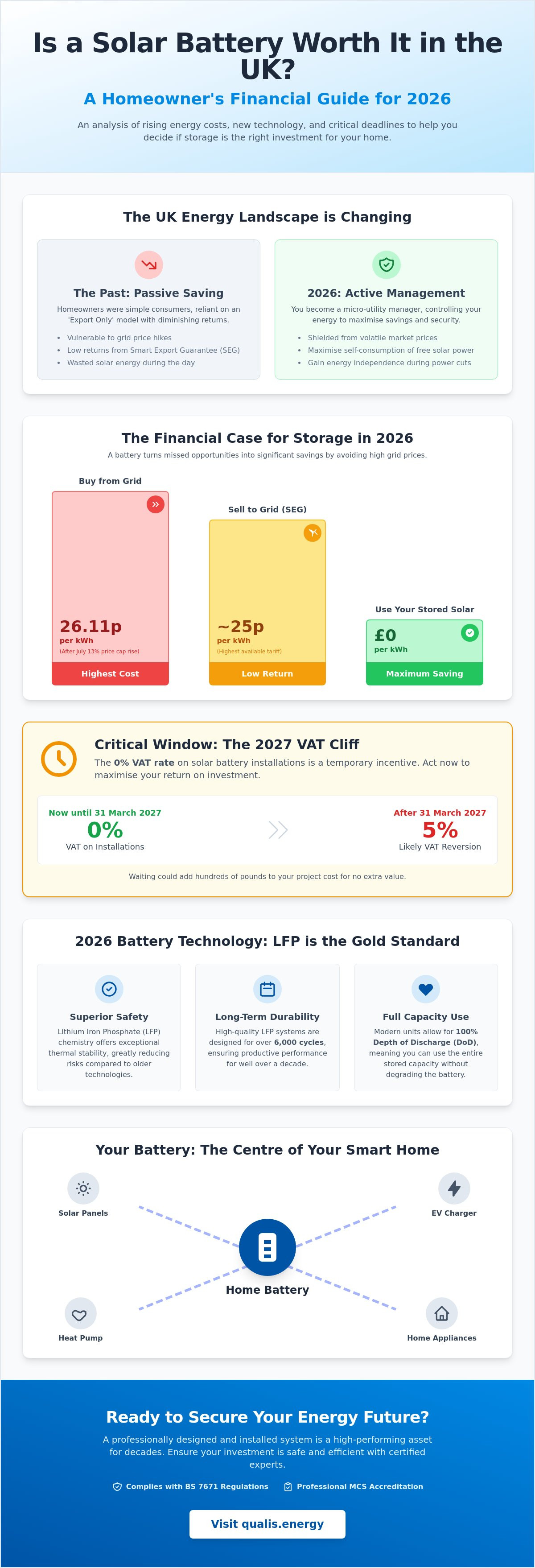
The traditional 'Export Only' model is rapidly losing its appeal. While the Smart Export Guarantee (SEG) offers some return, the gap between what you're paid for export and what you pay for grid electricity is widening. With the energy price cap rising by 13% in July 2026 to an average of £1,862 per year, every kilowatt-hour you send away is a missed opportunity to offset a 26.11p unit rate. By integrating battery energy storage systems, you retain your generated power for evening use when prices are highest. It's a simple calculation of keeping your cheapest energy for your most expensive hours.
In regions like the East Midlands and South Yorkshire, this transition represents more than just a lower bill. It's about local resilience. We're seeing a visionary shift in how Nottingham and Sheffield homeowners view their rooftops. They're no longer just surfaces; they're the foundations of a decentralised energy network that provides stability amidst national infrastructure volatility. This is the new standard for the modern British home.
The 2027 VAT Cliff: Why 2026 is the Critical Window
Timing is everything in infrastructure investment. Currently, you benefit from a 0% VAT rate on the supply and installation of domestic battery storage. This incentive is a significant driver for those asking is it worth getting a solar battery in the UK 2026. This tax relief is scheduled to end on March 31, 2027, likely reverting to 5%. Waiting until next year could add hundreds of pounds to your project costs without adding any extra value. Qualis Energy specialises in helping you secure your installation within this legislative window, ensuring your transition is as cost-effective as possible.
Energy Security and the UK Grid
Resilience is the new currency of homeownership. Modern systems offer 'Island Mode', a feature that allows your home to remain powered during local grid outages. As the national grid faces increasing pressure from the transition to electric heating and transport, local volatility is a growing concern. For families in the East Midlands, a battery acts as a silent guardian. It ensures your lights stay on and your essential appliances run, regardless of what's happening on the wider network. It's the ultimate peace of mind for a modern, electrified home.
Understanding Solar Battery Technology and 2026 Financial Incentives
Technology has matured rapidly. In 2026, Lithium Iron Phosphate (LFP) has emerged as the definitive standard for domestic storage, largely replacing older chemistries due to its superior thermal stability and exceptional lifecycle. These units are designed for the long haul. Most high-quality LFP systems now comfortably exceed 6,000 cycles, ensuring your investment remains productive for well over a decade. When evaluating is it worth getting a solar battery in the UK 2026, this hardware longevity is a primary factor in the positive return on investment we now see across the Midlands.
The financial framework supporting this technology is equally robust. The Smart Export Guarantee (SEG) has evolved into a competitive marketplace where savvy homeowners can access rates as high as 25p per kWh, particularly when they consolidate their solar and battery installation with a single provider. This creates a dual-revenue stream: you save by not buying from the grid, and you earn by selling your surplus at premium rates. Understanding the UK's 2026 energy landscape is essential for navigating these tariffs effectively as the government continues to prioritise decentralised, clean power through national initiatives.
Depth of Discharge (DoD) indicates the percentage of energy that can be extracted from a battery relative to its total capacity; in 2026, high-quality units allow for 100% DoD while maintaining a performance guarantee of 10 years or more.
AC vs DC Coupled Systems: Which Suits Your Home?
Choosing the right architecture is critical for system efficiency. DC-coupled systems are the gold standard for new installations because they avoid multiple conversion steps, keeping more of your generated power within the system. If you already have solar panels, an AC-coupled retrofit is often the most practical path forward. It allows for a seamless addition to your existing setup without requiring a total overhaul of your current inverter. Matching your inverter capacity to your peak domestic demand ensures you can actually draw enough power to run heavy appliances, like a kettle or oven, entirely from your stored reserves.
Smart Tariffs and Arbitrage: Making the Battery Pay
The real revolution of 2026 lies in 'Agile' or Time-of-Use tariffs. Modern battery management systems now use AI-driven software to monitor weather patterns and grid pricing in real-time. This allows for automated energy arbitrage: your battery can automatically charge from the grid during 'plunge pricing' windows when electricity costs are near zero or even negative. This intelligence is a cornerstone of renewable energy in the UK, turning a simple storage box into an active profit-generating asset. If you want to see how these smart systems could work in your home, our team can provide a bespoke performance forecast for our battery storage solutions.
Analysing the ROI: Is a Solar Battery Truly Worth the Investment?
Determining the true value of an energy asset requires a holistic view. To decide if is it worth getting a solar battery in the UK 2026, you must look beyond the initial purchase price and consider the 'Worth It' Framework. This balances hard financial ROI with lifestyle value and carbon reduction. While early adopters were often motivated by environmental altruism, today's homeowners are focused on 'Avoided Grid Cost'. This is the most significant economic factor in 2026. Every kilowatt-hour you store and use later replaces a unit you would otherwise buy from the grid at the 26.11p rate effective from July. It's a strategy of retention over transaction.
Payback periods have shortened significantly. Most households now see a full return on investment within 7 to 9 years. This acceleration is driven by the widening gap between export rates and import costs. Given that modern LFP units are designed to last 15 years or more, this leaves you with a long tail of pure profit. You're essentially pre-purchasing a decade of electricity at a fixed, lower rate. We view this not just as a purchase, but as a long-term hedge against a volatile energy market.
The Financial Breakdown: Storage vs. Export
The maths is simple but compelling. If you sell surplus energy to the grid, you might receive a modest export rate of 5p to 15p. However, if you store that same energy and use it during the evening, you avoid buying grid power at 26.11p or even 30p during peak demand. High-usage households, such as families or those working from home, see the fastest ROI because their self-consumption rates are naturally higher. The 'Opportunity Cost' of skipping storage during a solar panels and installation project is high. Adding it later often costs more in labour and logistics, missing the chance to maximise your savings from day one.
Non-Financial Benefits: The Value of Independence
There's a profound peace of mind that comes with energy security. During winter storms or periods of grid maintenance, your battery provides a silent, automatic backup. This 'Off-Grid' capability is becoming a priority for residents in Mansfield and Chesterfield who want to insulate their domestic comfort from external failures. Beyond the technical resilience, there's the pride of demonstrating environmental leadership. You're not just reducing your bills; you're actively participating in a national transition toward a cleaner, more stable infrastructure. It's a commitment to your community's future as much as your own.
Maximising Your Investment: Synergy with Heat Pumps and EVs
A solar battery is the central nervous system of a modern, low-carbon home. It's no longer just an optional storage box; it's the intelligent conductor that synchronises your generation with your heaviest demands. When homeowners ask is it worth getting a solar battery in the UK 2026, the answer often lies in how well that system integrates with other clean technologies. By discharging stored solar energy during high-demand evening windows, a home battery ensures your air source heat pump remains carbon-neutral and cost-effective without relying on the grid's most expensive unit rates.
The "Solar-to-EV" advantage is another pillar of this 2026 investment strategy. With one in four new car purchases in the UK now being electric vehicles, the ability to drive on 100% self-generated sunshine is a game-changer for household logistics. Instead of exporting surplus energy for a few pence during the day, you're essentially "tanking" that power into your vehicle or home storage to offset the 26.11p electricity rate. This creates a closed-loop system where your roof powers your commute, removing the sting of rising fuel and energy costs in one go.
The Whole-Home Energy Strategy
We believe in a unified approach to domestic infrastructure. Qualis Energy specialises in coordinating air source heat pump installation with bespoke battery sizing to ensure your system handles the specific surge loads of seasonal heating. A heat pump's efficiency is legendary, but its demand can spike when the sun isn't shining. Sizing your battery correctly allows you to "time-shift" your solar harvest from midday to midnight, creating a seamless renewable ecosystem that maintains comfort without compromise. To see how a tailored system can transform your home's efficiency, you can explore our full range of battery storage solutions.
Future-Proofing for Electric Transport
The debate between Vehicle-to-Home (V2H) technology and stationary battery storage is evolving. While V2H offers exciting possibilities, a dedicated home battery remains superior for daily resilience. It doesn't leave the driveway when you go to work, and it doesn't add unnecessary cycle wear to your vehicle's expensive drivetrain. As we march towards the 2030 targets, ensuring your 2026 system is scalable is vital. We design our installations with future growth in mind, allowing you to expand your storage capacity as your family's fleet of electric vehicles or heating requirements grow. It's about building a foundation that lasts for decades, not just a single parliament.
Securing Your Energy Future with Qualis Energy
The transition to a decentralised energy future requires more than just hardware; it demands a partnership built on technical precision and local accountability. Qualis Energy stands as a leader in this national transition, providing MCS-accredited excellence across the East Midlands. When you ask is it worth getting a solar battery in the UK 2026, the answer is only a definitive 'yes' if the system is engineered to perform for the next two decades. We've built our reputation on this exact principle of longevity and reliability.
We reject the industry trend toward "one-size-fits-all" battery kits. Every property in Newark and Worksop has a unique energy signature, and our bespoke design process reflects that reality. By meticulously matching storage capacity to your specific generation potential and consumption patterns, we ensure you aren't paying for capacity you don't need or missing out on savings through undersized hardware. This tailored approach is what transforms a simple installation into a high-performing financial asset.
Why Local Expertise Matters
Local knowledge is the bridge between a visionary concept and a functional reality. Navigating the specific grid constraints and local planning nuances in Southwell and Ollerton requires an installer who understands the regional infrastructure. Our heritage isn't just in storage; it's rooted in comprehensive renewable care, including expert air source heat pump servicing. This end-to-end capability means we don't just install your system and disappear. We provide the ongoing maintenance and support necessary to ensure your investment remains at peak efficiency whilst the UK's energy market continues to evolve.
The Qualis guarantee combines visionary technology with grounded, professional support. We take pride in being more than a service provider; we are advocates for your energy independence. Our team manages every technical detail, from initial DNO applications to final commissioning, removing the burden from your shoulders. It's about providing a seamless experience that allows you to enjoy the benefits of is it worth getting a solar battery in the UK 2026 without the administrative headache.
Your Path to Energy Independence
Moving from curiosity to a commissioned system is a streamlined, professional journey. It begins with a comprehensive technical survey of your home or business, where we assess your current infrastructure and future aspirations. We provide a detailed proposal that outlines your expected ROI, self-consumption rates, and carbon savings. Once you're ready to proceed, our highly organised installation teams take over, ensuring a clean, compliant, and efficient setup that respects your property and your time.
Your journey toward a resilient, low-carbon lifestyle is just one conversation away. We invite you to take the next step and Request your bespoke 2026 Solar & Battery proposal from Qualis Energy today. Let us help you secure a future where your energy is clean, your bills are controlled, and your home is truly your own.
Take Command of Your Energy Independence
The transition to a decentralised grid is no longer a future prospect; it's a present reality. By now, the answer to is it worth getting a solar battery in the UK 2026 should be clear. It's a strategic move to lock in 0% VAT savings before the March 2027 deadline; it's also a vital step in creating a high-performing synergy between your solar panels, electric vehicles, and air source heat pumps. You aren't just buying a storage device. You're investing in a resilient energy hub that shields your household from market volatility and rising unit rates.
Qualis Energy is here to facilitate this journey with grounded expertise. As MCS Accredited Installers serving Nottinghamshire and South Yorkshire since 2021, we specialise in the complex synergy between solar PV and ASHP technology. We handle every technical detail and DNO application, ensuring total convenience for your household. It's time to move from being a passive consumer to an active energy manager with an expert hand to guide you.
Secure your energy future with a bespoke Solar & Battery quote from Qualis Energy
Your home's potential is waiting. Let's build a cleaner, more independent future together.
Frequently Asked Questions
How long do solar batteries actually last in the UK climate?
Modern Lithium Iron Phosphate (LFP) batteries typically last between 10 and 15 years, often exceeding 6,000 cycles before significant degradation occurs. The UK's temperate climate is actually quite favourable for battery health, provided the unit isn't exposed to extreme temperatures. Newer 2026 regulations now prohibit loft installations to ensure better thermal management. This ensures your investment remains a high-performing asset for its entire warrantied lifespan.
Can I add a battery to my existing solar panel system in 2026?
Yes, you can easily retrofit a battery to an existing solar array using an AC-coupled inverter. This setup allows the battery to sit alongside your current system without needing to replace your original solar inverter. It's a popular way to answer the question: is it worth getting a solar battery in the UK 2026? You'll still benefit from the 0% VAT rate on the installation until March 2027.
Will a solar battery still work during a power cut?
A solar battery will only provide power during an outage if it's installed with an "emergency backup" or "island mode" function. Standard grid-tied systems usually shut down during power cuts for safety reasons. If resilience is a priority, we can install a gateway that automatically disconnects you from the grid during a fault. This allows your home to continue running on stored solar energy until the local network is restored.
How much space do I need for a typical 10kWh home battery?
A typical 10kWh battery is roughly the size of a slimline boiler or a standard central heating radiator. Most modern units are designed to be wall-mounted or floor-standing in a utility room, garage, or external enclosure. Following the BS 7671 Amendment 4 regulations published in April 2026, batteries can no longer be installed in lofts. We'll help you identify a compliant, space-efficient location during your technical survey.
Is there any government funding or grants for solar batteries in 2026?
The primary financial incentive in 2026 is the 0% VAT rate on battery storage installations, which remains in place until 31 March 2027. While there aren't direct "cash" grants similar to the Boiler Upgrade Scheme, this tax relief represents a significant reduction in your upfront investment. Combining storage with a Smart Export Guarantee (SEG) tariff further enhances the financial viability of your system by allowing you to earn from surplus energy.
Do solar batteries require regular maintenance or servicing?
Solar batteries are solid-state devices with no moving parts, so they require very little hands-on maintenance. However, we recommend an annual health check to ensure the firmware is up to date and the thermal management systems are functioning correctly. Qualis Energy provides comprehensive maintenance and servicing to keep your system optimised. Regular monitoring via your mobile app will also alert you to any performance anomalies that might require a professional look.
Can I install a solar battery without having solar panels?
Yes, you can install a standalone battery to take advantage of "grid arbitrage" using smart time-of-use tariffs. This strategy involves charging your battery from the grid during cheap off-peak hours, such as overnight, and using that stored energy during expensive peak periods. It's an effective way to lower monthly bills even for homes that don't have a suitable roof for solar PV. It's a proactive approach to modern energy management.
What is the best size battery for a 4-bedroom house in Nottingham?
For a typical 4-bedroom home in Nottingham, a battery capacity between 10kWh and 15kWh is usually the "sweet spot". This size generally covers the evening and overnight baseload of a busy family home. If you have an electric vehicle or an air source heat pump, you might consider a larger or modular system that can scale. We provide bespoke sizing based on your actual half-hourly energy data to ensure maximum self-consumption.


Comments